
Analysis could help steer efforts for future management of the plant, other invasive species

Tall stalks of phragmites blow in the wind on the shore of the Nanticoke River in Dorchester County. Photo by Joe Zimmermann/DNR
The common reed, or Phragmites australis australis, has a bad reputation.
The tall, fast-growing plant—often simply called phragmites—is invasive in North America and widespread in the Chesapeake Bay region. The grass has received the scorn of environmentalists and coastal property owners alike for crowding out native plants and covering marshes with dense, difficult to remove thickets of pale green stalks.
But a new paper authored by a Maryland Department of Natural Resources scientist takes a more nuanced approach to phragmites, finding both advantages and disadvantages that the plant brings to wetland ecosystems.
“People often assume that phragmites is harmful,” said Dr. Elliott Campbell, DNR’s director of the Office for Science and Research and lead author on the paper, published in March in Wetlands Ecology and Management. “But we wanted to look at what the science actually says, and what we found is that it’s a much more complicated picture.”
Taking the approach of a cost-benefit analysis of phragmites, the paper found that phragmites ultimately perform similar functions that native plants do, with some trade-offs. While the invasive plant is less preferential as habitat for some species of conservation concern, phragmites is better at sequestering carbon than other marsh plants.
Phragmites australis australis has a long history in the Chesapeake Bay, with the earliest confirmed sample collected in 1883, from Chesapeake Beach. After originating in the Middle East, the reed came to North America by way of Western Europe, possibly through ballast water or bedding material on ships.
The reed, now abundant in many states, is an unusual invasive species because there are two native reeds of the same species but different subspecies. Phragmites australis americanus, the native type, is still present in Maryland, though the invasive phragmites has become more dominant.
For the analysis, DNR’s Campbell, together with NASA research scientist Dr. Anthony Campbell, reviewed existing scientific literature on phragmites in the Chesapeake Bay region through the lens of several “ecosystem services,” including carbon sequestration, nutrient removal, wave energy reduction, and wildlife habitat.
By looking at these different ways that phragmites functions in comparison to a native marsh , the scientists could compare the cost of managing phragmites (removing it from an area with repeated herbicide treatment) to the benefit of protecting or reestablishing a native marsh system.
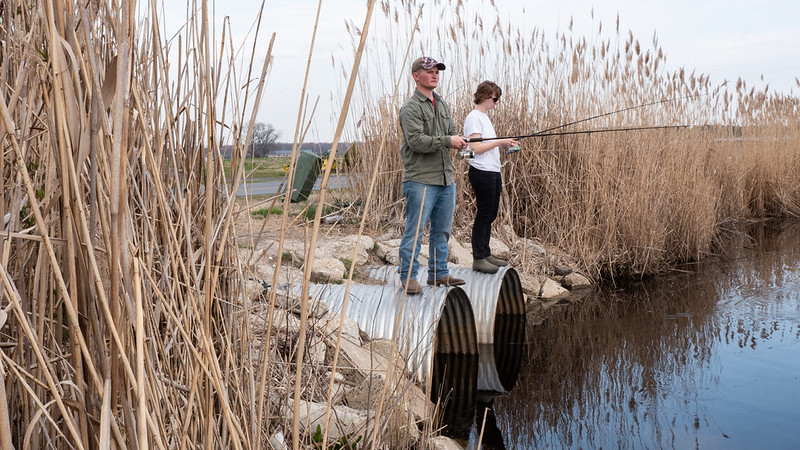
At the water’s edge lined with phragmites, two anglers cast lines for Chesapeake Channa, or northern snakehead, in Blackwater National Wildlife Refuge. DNR photo
Phragmites reeds are good at storing carbon from the atmosphere, an important environmental function as atmospheric carbon dioxide contributes to climate change. The analysis found that, on the whole, phragmites reeds appear to have up to three times higher average rates of carbon sequestration relative to native marsh plants, because the plants grow fast, retain their stalks through the year, and form thick mats of rhizome root systems.
Comparing the levels of nitrogen removal, the analysis found that phragmites reeds on average were similar to native high marsh, although native high marshes had a broader range and the best-performing areas of native marsh were better at removing nitrogen. Previous research has found that phragmites was equivalent or slightly better for reducing wave energy and storm surges, so this study assumed a similar ecosystem value for phragmites and native marshes for dissipating waves.
The paper challenged common concerns about phragmites on habitat quality, finding literature evidence that phragmites supports many kinds of wildlife and has had little impact on fish, mammals, amphibians, and even soil microbes.
Phragmites reeds support a similar abundance of birds and provide critical habitat for some nesting birds. However, several species of conservation concern—such as the salt marsh sparrow, willets, and rails—prefer native high marsh and are not known to nest in phragmites.
“Once you consider all those factors, in many areas of high phragmites concentration, it’s probably not worth controlling for phragmites because your probability of successful removal and the net benefit of doing so is low,” Campbell said. “Where that starts to flip is if you’re in one of these areas with a species of concern or where phragmites is in low abundance, then it could make sense to control for phragmites.”
Campbell said he hopes to create a tool that will map phragmites in the region as well as areas with species of concern and priority marsh habitats, which would allow DNR and land managers to make informed decisions on where to focus efforts for phragmites control.
While phragmites seems to help marshes shore up against erosion and sea level rise, the study noted that there is not enough data to compare them to Chesapeake Bay native marshes and highlighted that topic as an area for future research.
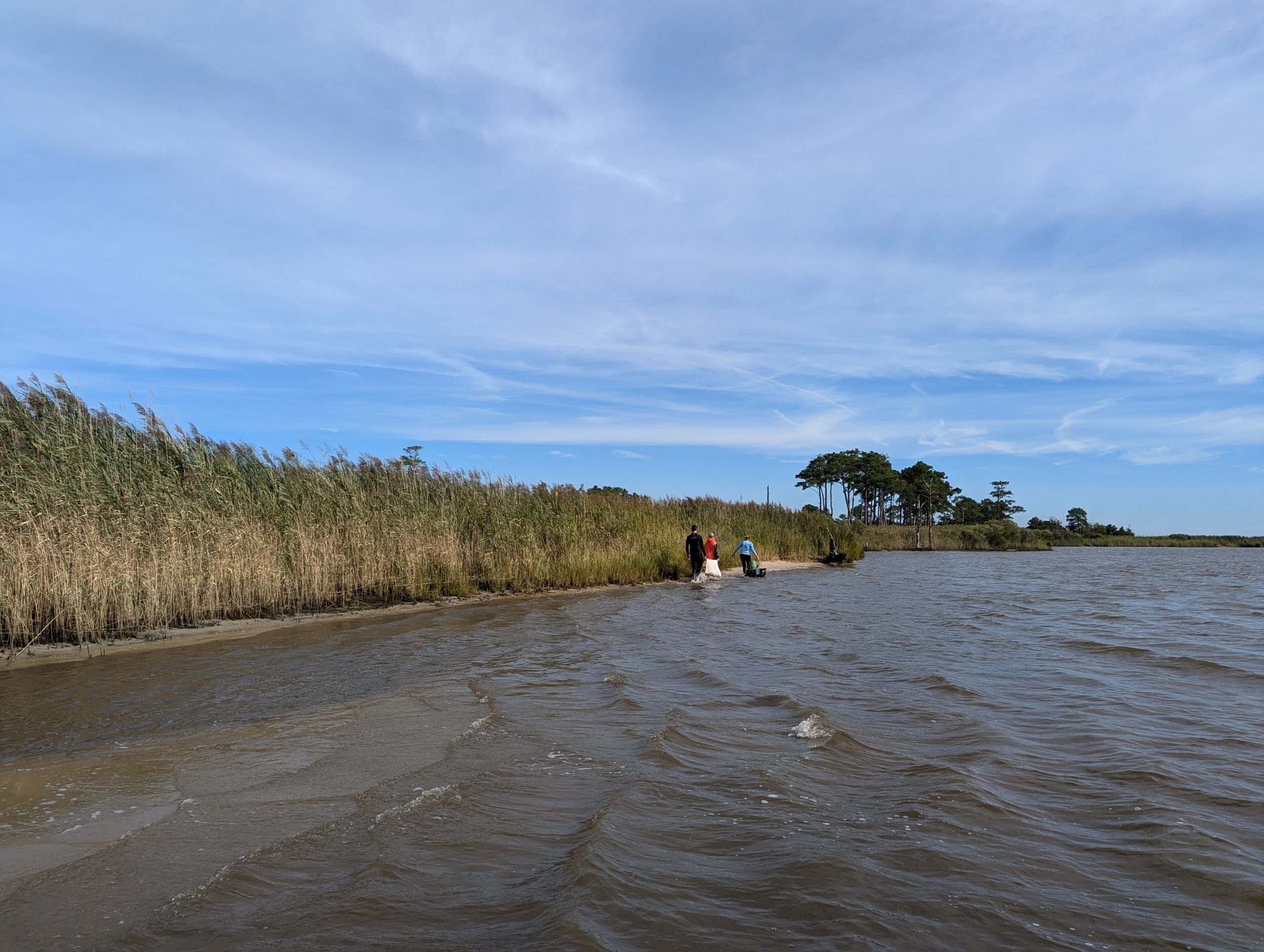
Thickets of phragmites cover the entire shoreline and tower over DNR fisheries biologists conducting a survey along the Nanticoke River. Photo by Joe Zimmermann
Invasive phragmites reeds—for better or worse—are here to stay. With eradication unlikely, Campbell said it’s good to fully understand the effects the plant is having on the ecosystem so that management can be targeted in the most beneficial way.
Campbell said the study represents a new approach to invasive species management, and that thinking about the costs and benefits for particular species in specific areas can be a useful framework for other species as well.
“It challenges the widely held belief that we always need to be fighting invasive species everywhere,” he said. “There’s no going back to the ecosystem that’s like the one that existed in the past, particularly pre-Western colonization. So we need to think about what’s the most realistically achievable and beneficial ecosystem in our novel environment.”
The Maryland Department of Natural Resources has historically managed and worked to eradicate phragmites throughout areas surrounding the Chesapeake Bay and continues to do so. The department is taking this study and other research on phragmites into consideration for its own management efforts in the future.
By Joe Zimmermann, science writer with the Maryland Department of Natural Resources
