

Chinese Neurosurgical Journal Study Probes How Skull Implant Design May Shape Surgical Outcomes
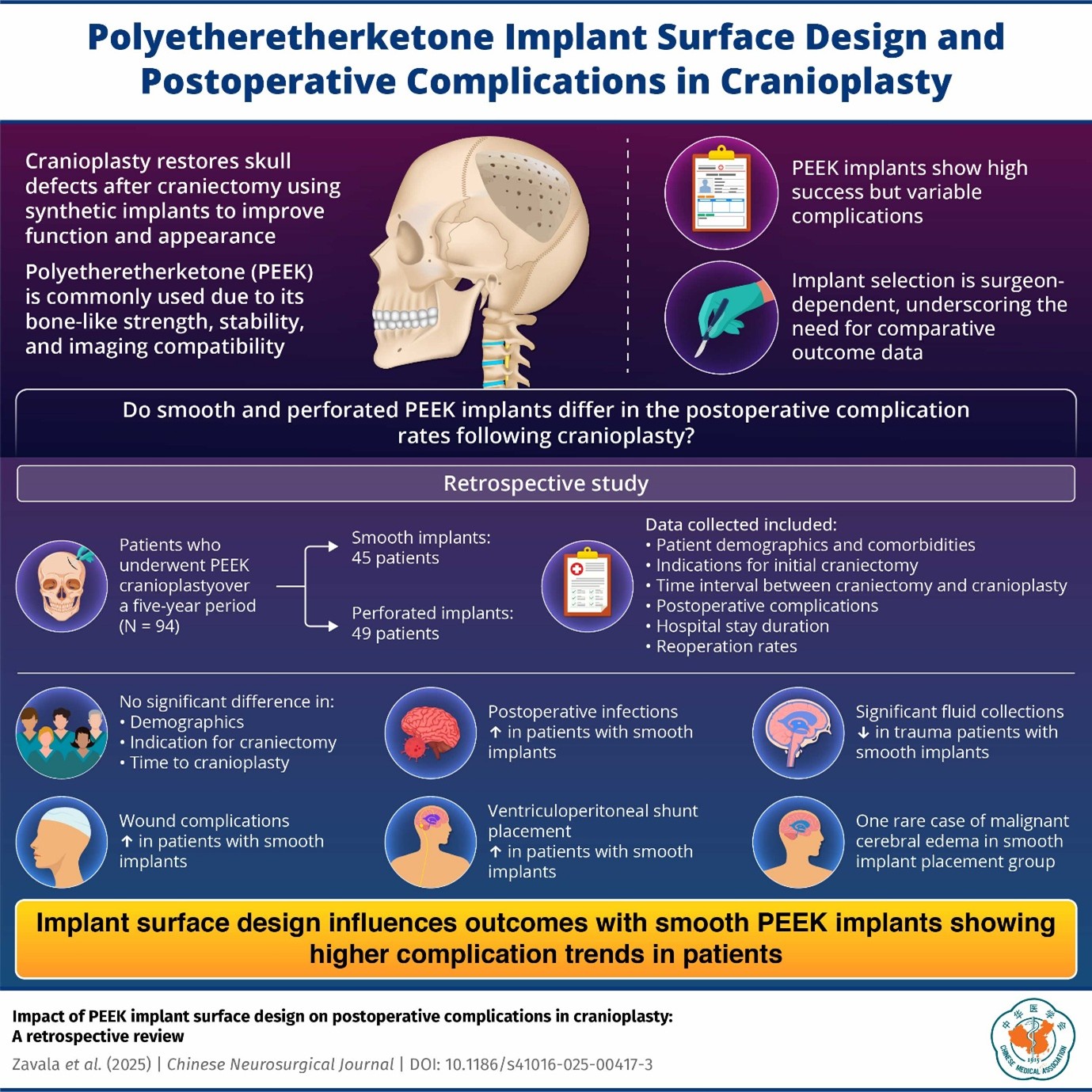
Comparison of postoperative outcomes associated with (A) smooth and (B) perforated polyetheretherketone (PEEK) cranioplasty implants.
Retrospective analysis compares smooth and perforated polyetheretherketone implants, revealing trends in postoperative complications
BEIJING, BEIJING, CHINA, February 2, 2026 /EINPresswire.com/ -- Polyetheretherketone (PEEK) implants are widely used in cranioplasty, yet the clinical significance of implant surface design remains unclear. A recent study compared postoperative outcomes associated with smooth and perforated PEEK implants. While overall complication rates were similar, trends indicated higher wound complications and infections with smooth implants, including a rare case of malignant cerebral edema. The findings highlight the potential role of implant surface characteristics and the need for further prospective studies.Cranioplasty is a routine yet critical neurosurgical procedure used to repair skull defects following decompressive craniectomy. Beyond restoring the skull’s protective function, the surgery can improve neurological recovery and cosmetic appearance. Surgeons may reconstruct the skull using the patient’s own bone or synthetic materials, but each option presents trade-offs. While autologous bone flaps are traditionally preferred, high complication rates have driven a growing interest in synthetic alternatives.
This shift has placed increasing attention on the safety and performance of artificial implants. Among these, polyetheretherketone (PEEK) has emerged as a favored material because it closely mimics bone’s mechanical properties, is radiolucent, compatible with MRI and ultrasound, and can be precisely customized using computer-aided design. Yet, despite these advantages, complications such as infection, wound breakdown, and postoperative fluid accumulation remain to be common challenges. What remains unclear is whether subtle differences in implant design—rather than material choice alone—may influence patient outcomes.
To address this gap, a research team comprised of Ms. Carmen A. Zavala, along with other researchers Dr. Laura Zima, Ms. Subhiksha Srinivasan, Mr. Sanjay V. Neerukonda, and Dr. Mark J. Dannenbaum, from The University of Texas Health Science Center at Houston, Texas, USA, examined whether implant surface architecture plays a role in postoperative recovery following cranioplasty. Specifically, the team compared smooth, solid PEEK implants with perforated PEEK implants designed with small holes to facilitate drainage or fixation. This paper was made available online on November 21, 2025 and published on 1 December, 2025 in Volume 11 of the Chinese Neurosurgical Journal.
Rather than relying on controlled experimental conditions, the researchers chose a real-world approach. They conducted a retrospective review of 94 adult patients who underwent PEEK cranioplasty at a single institution between 2017 and 2022. 45 patients received smooth implants, while 49 received perforated implants. They analyzed patient demographics, comorbidities, surgical indications, timing between craniectomy and cranioplasty, postoperative complications, length of hospital stay, and the need for revision surgery. Multivariate statistical modeling was used to adjust for potential confounding factors.
“This study reflects everyday neurosurgical decision-making, where implant choice is often driven by surgeon preference rather than comparative evidence,” Ms. Zavala explains. “We wanted to determine whether surface characteristics might be associated with differences in patient outcomes.”
At the population level, the findings were reassuring. The study found no statistically significant differences between smooth and perforated PEEK implants across major clinical outcomes, including infection, wound complications, significant fluid collections, return to the operating room, implant removal, or length of hospital stay. Demographic and baseline clinical characteristics were also well matched between the two groups.
However, looking beyond statistical thresholds revealed a more nuanced picture. Patients who received smooth implants showed higher rates of wound complications and postoperative infections than those who received perforated implants. Although these differences did not reach statistical significance, similar trends persisted even after adjusting for patient-related risk factors, suggesting that implant design may in fact influence healing in subtle ways.
Further complexity emerged when outcomes were analyzed by injury type. Among trauma patients, an interaction analysis revealed a statistically significant reduction in major postoperative fluid collections in those who received smooth implants. This finding highlights that implant performance may depend on the clinical context, reinforcing the idea that a one-size-fits-all approach to cranioplasty may be insufficient.
The study also documented a rare and previously unreported case of malignant cerebral edema following placement of a smooth PEEK implant. While malignant cerebral edema has been described with other implant materials, this single case does not establish causation. Nevertheless, it underscores the importance of continuous surveillance and transparent reporting of rare but severe complications.
“PEEK is chemically inert, which may limit tissue integration compared with more porous materials,” Ms. Zavala notes. “Our findings suggest that surface architecture could still influence postoperative healing, even if large differences were not detected in this cohort.”
Taken together, the results add meaningful evidence to a growing effort for optimizing implant selection in cranioplasty. Although no definitive superiority was identified, the observed trends and contextual effects point to the need for larger, prospective studies. Over the next five to ten years, similar research could help neurosurgeons tailor implant choices to patient characteristics and injury mechanisms, reducing complications and improving long-term outcomes.
Reference
Title of original paper: Impact of PEEK implant surface design on postoperative complications in cranioplasty: a retrospective review
Journal: Chinese Neurosurgical Journal
DOI: 10.1186/s41016-025-00417-3
About The University of Texas Health Science Center, Houston, Texas, USA
The University of Texas Health Science Center at Houston (UTHealth Houston) is one of the nation’s leading academic health institutions, dedicated to advancing biomedical research, education, and patient care. Through its schools of medicine, nursing, public health, dentistry, and biomedical sciences, UTHealth Houston integrates cutting-edge research with clinical innovation. The institution is nationally recognized for excellence in neuroscience, trauma care, and translational medicine, fostering interdisciplinary collaboration to improve health outcomes locally and globally.
Website: https://catalog.uth.edu/
About Ms. Carmen A. Zavala from The University of Texas Health Science Center
Ms. Carmen A. Zavala is currently an MD–PhD candidate at the McGovern Medical School, University of Texas Health Science Center at Houston, USA. Her research interests lie at the intersection of neurosurgery, clinical outcomes research, and translational neuroscience, with a focus on improving surgical decision-making through evidence-based analysis. She has authored two peer-reviewed publications and is actively involved in multidisciplinary research aimed at optimizing patient safety and long-term outcomes in neurosurgical care.
Funding information
This research did not receive any specific grant from funding agencies in the public, commercial, or not-for-profit sectors.
Yi Lu
Chinese Neurosurgical Journal
1059978478 ext.
luyi617@sina.cn
Legal Disclaimer:
EIN Presswire provides this news content "as is" without warranty of any kind. We do not accept any responsibility or liability for the accuracy, content, images, videos, licenses, completeness, legality, or reliability of the information contained in this article. If you have any complaints or copyright issues related to this article, kindly contact the author above.
